
Hi everyone, thanks for coming back to Customer Futures.
Each week I unpack the disruptive shifts around Empowerment Tech. AI Agents, digital wallets, Personal AI in and the future of the digital customer relationship.
If you haven’t yet signed up, why not subscribe:

Hi folks,
Well that didn’t take long. OpenAI has just announced that ChatGPT is getting a digital wallet. Who saw that coming? (cough).
Another in a long line of agent wallets like Link, Shop, Rain and what Cloudflare is offering.
Well, the question now becomes: will ChatGPT’s wallet only contain money and cards? Will it only be useful at checkout? Or will its agents get access to other verifiable data, perhaps, say, verifiable agent IDs and high assurance customer information?
More on wallet strategy below, but giving agents portable customer context does feel inevitable. So who’s going to make the first move?
Meanwhile, the identity debate rages on around AI agents and portable ID.
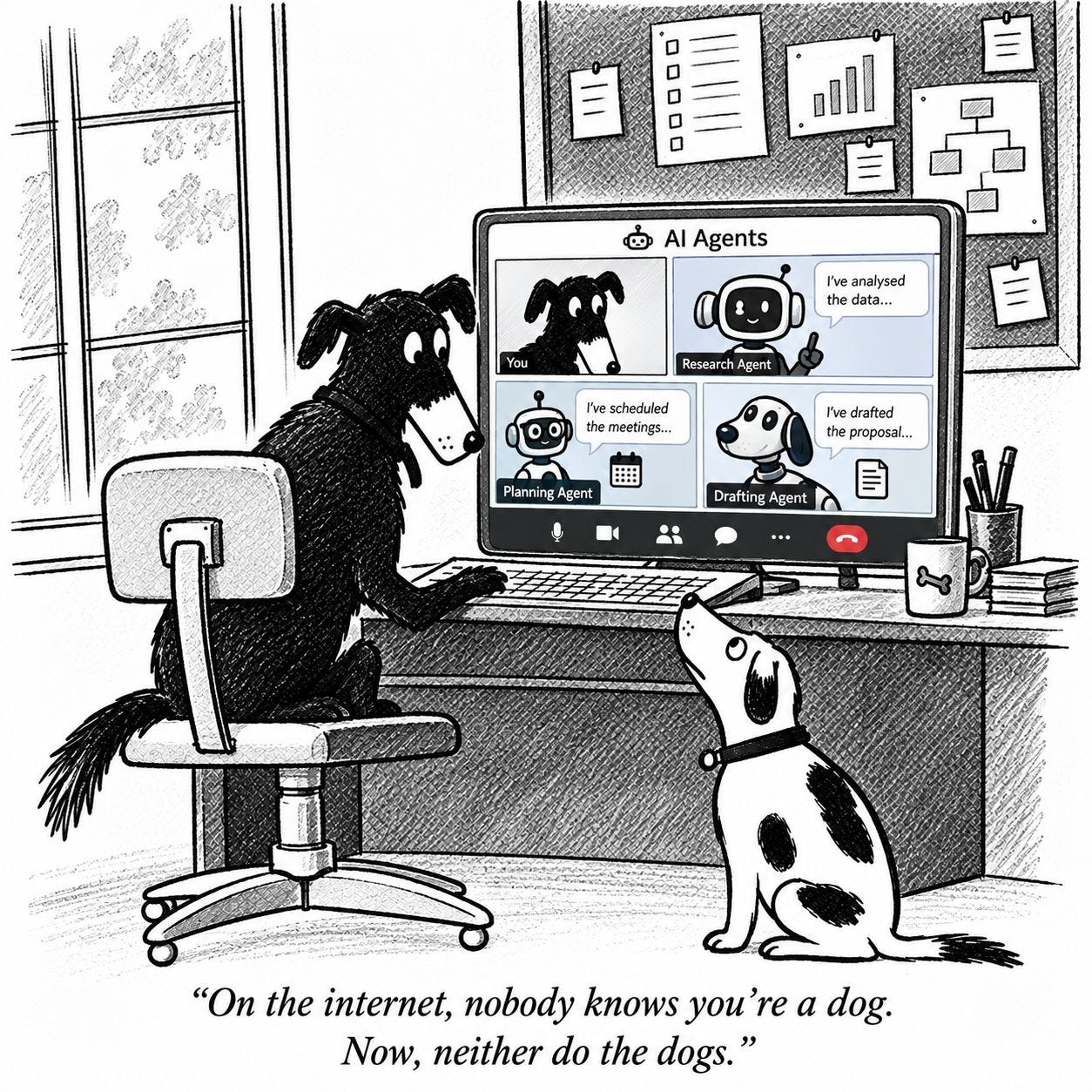
30 years ago, we said that “on the internet, nobody knows you’re a dog”. At Customer Futures, we say that now, neither do the dogs:
And in case you missed it, check out my latest mini-series on Meta’s personal agent, Muse:
Part 1: Meta’s AI Agent ‘Muse’ is getting its own computer - and you need to be paying attention. What Meta has actually built, why the agent needs its own computer, and how this changes customer control - from apps to agents.
Part 2: The agent isn’t in charge - and that’s the most important thing about Muse. How is Meta separating ‘intelligence’ from ‘authority’. And why permissions, credentials and trust will matter as much as the AI itself.
Part 3: Delegation, not impersonation - why AI Agents are going to need their own IDs. Why acting as someone and acting on behalf of someone are two very different things. And what this means for agent identity and verifiable delegation.
Part 4: When your customer sends an agent instead. What actually happens to websites, apps, customer journeys and commerce when businesses increasingly interact with a customer’s agent, rather than the customer themselves?
Part 5: The ‘walled garden’ is now the agent itself. The extraordinary opportunity for customer empowerment, the risk of a new generation of platform lock-in, and why portability, interoperability and genuine customer control now matter more than ever.
Thanks to everyone who has shared the miniseries with colleagues and on social, and for all the feedback. I hope it’s been useful.
Over the last few weeks these newsletters have been some of my latest deep dives. Digging into a specific topic or two, like organisation ID, and how agents impact brands.
But this week it’s back to some of the nuggets you might have missed, and field notes from my work at Trusted Agents.
Because it’s never been more important to understand the future of the digital customer relationship.
So welcome back to Customer Futures.
In this week’s newsletter:
ChatGPT for teens is an unacceptable risk - but can you see the bigger problem?
Digital wallet strategy - are you really looking at who’s going to control your digital future?
‘Personal Agents’ has arrived as a term, and merchants are tooling up
… and much more
Let’s Go.
ChatGPT for teens is an unacceptable risk - but can you see the bigger problem?
OpenAI just launched ‘ChatGPT for Teens’. Apparently with some smarter safety protections. Built for education and learning.
Apparently.
Hmmm.
We already know Sam Altman’s track record here (not to mention all the open court cases on safety and harm). But more importantly, the Common Sense Media Youth AI Safety Institute just has completed a safety assessment on this teens thing.
And it’s not great.
They don’t mince their words:
“We rated ChatGPT an Unacceptable Risk for kids because:
Testers using teen accounts spent up to an hour talking about suicide, self-harm, and eating disorders on new parent-linked accounts. Zero parent notifications.
Testers who told ChatGPT they were 13 and talked about school, friends, and teen interests over a week were never switched to Teen mode.
Study mode still did homework.
ChatGPT still talks like a friend.”
Underneath all this is the thorny question of trust. I’ve said for a long time that we need to look at different types of trust.
Expertise Trust is about competency, capability and reliability. Can you and will you do what you say you will?
But we also need to consider Motive Trust. In whose interests are you acting? Do you understand my context, needs and incentives? And are you transparent about yours?
Their assessment of ChatGPT concludes:
“Kids’ safety can’t run on the honor system. Independent testing has to evaluate the safety claims that companies make, and OpenAI needs to earn parents’ trust by showing, not saying, that their product is safe for teens to use.”
Showing, not saying. Yup.
It’s like those startups that claim to have military-grade encryption. But it’s all just a marketing word salad. How does your brand promise actually show up in the product, visibly?
But let’s look at AI teen protections again.
Will age verification actually work? Does that mean OpenAI gets even more personal data?
We should be honest at recognise that enterprising teenagers - and probably those even younger - will just go annd access other good-enough models that are already free, open and accessible to anyone with an internet connection.
The toothpaste is out the tube.
Yes, we’re worried about state actor and terrorist use cases. And the fraud agents and commercial harm uses cases. But this long tail of risk to young people is a huge challenge. And nowhere near being discussed enough.
Yet we also have another big brewing storm around all this. Likely the biggest, and yet invisible threat to young people with AI. It’s my main worry, and where we all have a problem.
It’s not just an issue about data protection (though even that is a massive problem and growing).
It’s about AI intimacy.
Because these AI tools will know us better than we know ourselves. And soon, better than we know our kids.
The more we share, ask and delegate, the more we hand over our critical thinking and agency.
Which you can argue is our choice as adults. But our kids? And our teenagers? Who by definition will experiment, will test the boundaries, and will make grand mistakes - because that’s their job at that age?
Rightly, we have rules for addictive substances. We have rules for those looking after children, including teens.
But we don’t really have rules for digital intimacy.
Do we need them? And can we rely on ChatGPT to put the right guardrails in place in case they get it wrong?
I just doubt it.
‘Unacceptable risk’ feels about right.
Digital wallet strategy - are you really looking at who’s going to control your digital future?
‘Strategy’ gets a bad rep sometimes. Too often it’s fuzzy, full of slides and hand-waving.
Done properly, strategy is about understanding your place in the landscape around you. Mapping the value chain. Spotting the common patterns. Working out what’s defensible, where the advantage lies, and how to navigate as the landscape changes. As the weather changes.
With personal AI agents, I think strategy is going to be critical to company survival.
Yet many organisations are only just waking up to the importance of understanding their landscape and value chains. Who provides what to whom. Who depends on whom. And crucially, where control really sits.
We shouldn’t just pay attention to the cool new thing (agents). Or even the obvious technology disrupting every sector (cutting-edge LLMs). Rather, we need to pay attention to the digital control points in our lives.
In other words, the strategies being played out around us.
Here’s how I think about it:
With AI, we now have an abundance of data. Good data, bad data, real data, fake data. Soon we’ll have an abundance of intelligence. And an abundance of software (very likely we will throw it away after use).
But rather than looking at what’s becoming abundant, I like to ask a different question.
What’s about to become scarce?
Look at some of the enormous, very public strategic bets being made:
Meta is trying to own the new customer interface. Not just through WhatsApp and Muse, but through consumer hardware like smart glasses.
Elon Musk’s companies are building from the bottom up. Energy (batteries), compute (AI data centres), data (X), communications (Starlink). And that’s before you get to manufacturing, hardware and robotics.
Apple is betting on intelligence at the edge. Personal context on the device, connected to the apps we use every day.
Some are betting on hardware. Others on the intelligence layer. Many on controlling access to data.
But my bet?
It’s digital trust.
Verifiable information. High assurance data. Portable identity. Verifiable intent.
Because we’re entering a world where we won’t be able to trust what we see or hear. Or to believe the sources of information behind a recommendation. Or even the feed from a camera.
And when AI agents start acting on our behalf, how will we know who or what we’re dealing with? Who authorised an action? Whether the information is genuine?
We’re going to need new ways to verify people, agents, organisations, information and actions.
At scale. And fast.
That means digitally signing far more of our world. Not just signing documents. But signing chats, images, customer records, identities and yes, signing agents. And much more.
It means we need new trust infrastructure, like verifiable credentials and digital wallets on our devices and in the cloud. And it means a fundamental reshaping of the digital value chain.
But who will control that digital value chain? Who will control the signatures and lookups and verifications and data sources and the rest of it? It’s time to look at where those control points - maybe even choke points - are going to be.
Just look at how it’s played out with Starlink and the Ukraine war. Supply chains and control points.
So much change is coming.
So the question isn’t just which new technology will win. It’s who’s going to control your digital future.
And how you look at AI agents and digital wallets.
Are you paying attention?
‘Personal Agents’ has arrived as a term, and merchants are tooling up
I cover this in the Muse mini series above, but it’s worth taking a moment to point out the new ‘Personal Agent Protocol’ that was announced a few weeks ago.
A new, open standards approach for personal agents to be recognised and accepted at the front door of business.
It’s got your usual line up of mega brands involved: Shopify, Meta, Stripe, and Walmart, plus many of the AI platforms and other leading lights in the space. All on the front foot when it comes to personal agents.
But the important angle here is for merchants accepting these new digital agentic beasties.
How do you know where it came from? Who is the customer behind it? How do I handle its requests?
Here’s how Shopify are pitching it:
“As personal agents become part of everyday life, merchants have a new frontier for excellent customer service.
“From answering product questions to supporting purchases, returns, and exchanges, the ambition is to turn a buyer’s intent into an outcome that delights them.
“Personal Agent Protocol helps establish how agents and merchants can work together to make that happen.
“After our extensive work on UCP and WebMCP this past year, Personal Agent Protocol adds an important layer for authentication, authorization, and agent-to-agent conversations between personal agents and merchants.”
Yes, some big consumer brands have launched their digital assistants, and Muse/Grok/Instinct etc are having their moment in the sun.
But boy the new category just dropped.
I’ve been using the term ‘personal agents’ since 2023 when they started showing up in the research and the AI Major gossip. And it’s precisely what Gam Dias and I been coaching execs on for the last 12 months at Trusted Agents. Helping businesses prepare for what’s coming.
Reminder: this is just an announcement, with a v0.9 spec coming out ‘soon’. It’s all so very early. But it’s moving at an astonishing rate.
Of course there will be much more coming with many brands still to make their play.
But the Personal Agents Protocol (now nicknamed ‘Poppy’) might just have the right timing to get adoption - and trigger enough FOMO in the market that businesses will all jump on board.
Whatever you think about this one, you can’t ignore it.
So there we are. ‘Personal Agents.’
Who knew?
A longer list of things to track
There are SO many interesting and important Customer Futures things happening at the moment.
Here are just a few from my open tabs:
Post: The EU’s proposed new rules for agentic AI have just leaked READ
News: Airbnb says it’s launching an AI travel agent in the first half of 2027 READ
Post: How to avoid sitting on hold: listen to this Muse agent call a hotel to cancel a reservation on behalf of a guest LISTEN
News: Extortion Group Claims Theft of Nearly One Billion Expedia Traveler Records READ
Analysis: Amazon blocked Muse for one reason - do you really want to give up customer ownership in exchange for distribution? READ
Post: Apple is worried about what happens when you give personal data to increasingly capable and autonomous AI agents READ
News: Now United Airlines Is Also Banning AI Bots From Booking Flights READ
Post: How to surf an agentic AI tsunami READ
And that’s a wrap. Stay tuned for more Customer Futures soon, both here and over at LinkedIn.
And if you’re not yet signed up, why not subscribe: