
Hi everyone, thanks for coming back to Customer Futures.
Each week I unpack the disruptive shifts around Empowerment Tech. AI Agents, digital wallets, Personal AI in and the future of the digital customer relationship.
If you haven’t yet signed up, why not subscribe:

Hi folks,
Question for you.
Do we really understand where identity fits in a business process? What data really needs to be collected? Is identity a thing in its own right? Or is it part of a wider customer experience?
Too many digital ID companies think they’re building products when in fact they are building features. To be embedded inside other, broader and more valuable customer experiences.
But to do that, we must better understand not just digital identity itself (there are three decades of debate on that, let’s not open that box), but what it means to add identity to another flow.
To better understand what identity is being added to, why, and from the customer’s perspective.
I’ve argued for the longest time that digital ID is missing a product sensibility. Thinking about the why and the how of the experience, not just the what. Certainly not ID for its own sake.
We need people thinking hard about ‘jobs to be done’. About ‘Nth use’, not just ‘1st use’. We need a business and commercial mindset, not just a technical, compliance or risk one, which seems to be so much of the ID team profile these days.
I think the root cause it pretty obvious.
Everyone is focussed on the customer transaction rather than the customer relationship.
We are down in the details of QR code scans and selfies and credential exchange and key rotation and verification taps and mDLs and regulations and proof of human.
All of those matter of course. But they are not the point. They are the enablers to what the individual is trying to get done.
As ever, Rory Sutherland puts it better than I ever can (watch from 59m00s). He talks about finance vs marketing.
“Marketers are trying to form a marriage, but finance people are trying to run an escort agency.
“The finance people are only interested in how many exchanges you have, not the durability of the exchange over time or the potential to actually engage in increasing value exchange over time.
“Fundamentally, trying to understand a market without understanding network science is like trying to attempt a moonshot with no understanding of gravity.”
Digital identity teams too often fall into the same trap. Getting excited about assurance levels and data points and IDV transactions. Not how it feels. Or the commercial implications around digital trust and permissions.
To understand the customer’s behaviours, motivations and constraints. To look beyond the technical and cryptographic. Beyond compliance, risk and QR codes.
Encouragingly, there are plenty of identity platforms and apps out there that now have over 500k or even 1M downloads.
Yet downloads and accounts are not adoption.
Do we really understand the difference between transactions and relationships? Between ‘users’ and ‘daily active users’. And what happens once digital identity becomes reusable, portable and private?
It’s never been more important to understand the future of the digital customer relationship.
So welcome back to Customer Futures.
In this week’s newsletter:
The next 5 years are going to be pretty exciting for banks - but only if you care about the customer
Is ‘wallet’ really the right language?
Do you really want someone else managing the keys to your front door?
… and much more
Let’s Go.
The next 5 years are going to be pretty exciting for banks - but only if you care about the customer
This chart below from David Jimenez Maireles, says more about a bank’s ability to focus on the customer than any of the analyst reports out there.
It shows the comparative rating of each bank’s customer experience over the last 5 years.
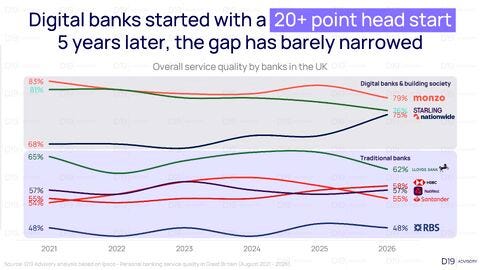
It’s striking how little has changed.
Yes, the big banks have legacy systems to deal with. And sometimes 150 years of culture to battle. Plus huge organisational structures and processes locked in concrete.
But CX is such an important factor that it’s confusing why banks don’t put more investment and thought into it.
Monzo, at the top of the chart, is now one of the UK’s largest and growing banks. No branches, great app, simple tools.
One of my favourite things about Monzo is that they have very little down time. If they have a system-wide problem, they just spin up their lightweight ‘shadow bank’. You can still use minimal features for the basics. Pay salaries, get through checkout at the supermarket, handle direct debits. Most of what you need day to day.
Yet when the other banks crash, they hit the headlines and have PR disasters - even get fined - because customers can’t get paid on time. And the supermarkets fall apart because they can’t take payments.
Anyway, one of the more obvious reasons why so few banks care about CX is the customer themselves. In the UK at least.
It’s because people don’t really switch banks.
Once you have a UK bank account, often set up in your early 20s, in any one year only about 2.5% of customers change provider. On average, it’s about once every 20 years.
That’s nuts.
So the logic becomes a little clearer. Why spend £MM to improve the bank’s CX when people just put up with the old, crap experience?
But that’s where it’s about to get interesting.
Let me explain.
Most people are pretty bad at managing their money. They forget to check their balance. They don’t research. They don’t set goals. They don’t get around to it.
But as we speak, personal financial software is getting pretty good once it’s plugged into AI. At remembering. At researching. At setting and managing goals.
And now with AI agents, that software can take action. Move money. Handle transfers. Track and manage savings pots.
We’re not there yet, of course. There’s lots still to do on liability, risk, governance, identity and stuff like agentic system access.
But it’s pretty clear that soon people will be using AI financial assistants to keep track of their money coming in and what they spend. To help them make day to day savings.
Banks don’t allow it yet. Nor do the regulators. Rightly. There’s too much that can and will go wrong.
But AI assistants for money are coming.
And some of the smart banks are preparing. They can see what’s happening to AI agents and shopping and mandates and permissions.
Why should you care?
Because the bank CX teams won’t just need to design for people. They will need to design for customer AI agents too.
I am speaking to a couple of banks at the moment who are looking ahead, who are thinking about ‘the agentic customer’.
I’m willing to bet that the banks that care most about CX will also care about AI agents.
Yes, the Big Old Banks will start making Big Moves into agentic. But as ever, so much comes down to company culture. About how fast you can move. About what you actually care about.
The next 5 to 10 years are going to be pretty exciting for banks.
But that’s only if you care about the customer. And great AI experiences.
Not just showing me pdfs of my balance.
Is ‘wallet’ really the right language?
I’m not sure we should assume there will be some grand central registry of ‘all global AI Agents.’ A kind of database in the sky for all AI identity.
Because AI Agents are naturally decentralised things. They race across borders, across sectors and use cases without a care for what the human rules say.
So rather than more and more federated agent ID checks and spaghetti APIs everywhere, it’s more likely we’ll see AI agents connected to their own identity and data ‘at the edge’.
Where agents can instantly prove who they work for, who operates them, their ‘binding’ to their owner, their permissions and so on.
In Fintech terms, digital wallets and credentials are in 2014. But the shift to agentic finance is going to happen quickly.
I can see a path to 200-300M digital ID wallets for humans over the next 24 months. Perhaps many, many more.
But if the idea of giving AI agents their own digital wallets takes off, as both META and Cloudflare have each recently announced, then we’ll be counting digital wallets in the billions pretty quickly.
Look at it the other way round.
Why on earth would the AI majors - and retailers for that matter - spend their time, money and risk profiles holding a vast amounts of ID data when they can just ask for the minimum info they need from other parties, via digital wallets?
KYC and KYA shouldn’t be the goal. ‘Digital trust’ should be.
Local AI agent registries? Sure. But centralised agent ID? Nope.
But the language here is a problem.
Because Agents won’t have ‘wallets’ any more than they will have digital driving licenses or passports or CVV numbers for payments.
As identity OG Eve Maler puts it
“It might not even make sense to count those things (or even think of them as “normal” wallets, vs. a sort of software-defined secure element), given the ephemeral nature of many agents.
“Several schemes for registering client apps were invented for open banking and healthcare, but all of them still suffer from the slow speed of business trust.
“With agents, we finally have a reason to scale up to the speed of what’s possible with technical trust.”
As ever, we apply new technology to old problems. Today we are creating digital versions of our leather wallets, to contain digital versions of loyalty cards, driving licenses, tickets and payment cards.
Just as we gave our early computers desktops and folders and trash cans, they were digital versions of what was already in front of us.
But real tech disruption happens when we create new things that weren’t possible before.
With digital those new things were newsfeeds, email and app stores.
So what’s new this time?
With AI agents we can create and scale things like real-time, high-frequency, agent-native identifiers, together with delegation frameworks to handle permission and scope of what those agents and sub-agents are allowed to do.
And things like agents accessing personal data vaults and stores that unlock portable personal context, preferences and customer history, plus things like personal terms for customer negotiation.
Wallets made sense in the physical world, and have been a handy metaphor as we transition to this new AI-enabled world.
But let’s be clear, AI agents are not going to be holding driving licenses, coffee stamps or movie tickets.
And digital wallets are probably not the right language for how they’ll show up.
Do you really want someone else managing the keys to your front door?
Some describe this as a ‘first world problem’.
But we must remember that your social media platform can take away your name/handle whenever they want.
They can also block you, decide what you see (and what is hidden), how your posts are shared with others, and of course what happens to your personal data.
When it’s a stream of cat photos, that’s probably fine.
But when that account is a core part of your social life, needed for daily communication, or even used to login elsewhere…. Then we have a problem.
Remember: if you use META‘s products to login elsewhere, if they shut you out, you just lost the keys to your front door.
When Mark Zuckerberg launched the new personal agent ‘Muse’, META kicked the band Muse off that same handle on Facebook, Instagram, and anything else that META controls.
All is fair in love and war, I suppose. It’s in the T&Cs, right?
But there are plenty of people who have been locked out without notice, because of some fraud attempt, or just bad password protection hygiene.
It’s just another example of a digital landlord who can change the locks whenever they want, like when Elon bought Twitter and steamrollered the owner of the account (at) X.
So which brand or person will get pushed out the way next?
I could be you.
So what are you doing about it?
A longer list of things to track
There are SO many interesting and important Customer Futures things happening at the moment.
Here are just a few from my open tabs:
Post: Customer service agents are about to be overwhelmed with Dots and Muses and Clawlikes negotiating for better deals using voice/chat READ
Analysis: Apple is worried about what happens when you give AI Agents access to your data READ
Idea: Martin Sorrell on why marketing is not getting more complicated with AI and agents - it is getting simpler READ
Post: Meta’s AI agent sent a stranger to a guy’s door READ
News: Booking.com joined Expedia and Airbnb: bye-bye guest phone numbers READ
Announcement: Yet Another Personal Agent Gateway (can you see the trend yet?) READ
And that’s a wrap. Stay tuned for more Customer Futures soon, both here and over at LinkedIn.
And if you’re not yet signed up, why not subscribe: