
Hi everyone, thanks for coming back to Customer Futures.
Each week I unpack the disruptive shifts around Empowerment Tech. AI Agents, digital wallets, Personal AI in and the future of the digital customer relationship.
If you haven’t yet signed up, why not subscribe:
Lunch in London: Trusted Agents x First Person Project Meetup - 8th May
Are you curious about Proof of Personhood, Personal AI and digital ID?
Drummond Reed from the First Person Project is in London next week, so we’re running a joint lunch meetup, and another Trusted Agents Table.
For those who want to dive into all things humans + AI agents + verifiable credentials!
When: 12pm on 8th May
Where: Dishoom Covent Garden
RSVP: If you’d like to join us, please let us know at jamie@thetrustedagents.ai.
Looking forward to seeing you there!
Webinar: Modernizing Government Services with Digital ID and Verifiable Credentials
I’m going to be hosting a new series of digital ID webinars with Carahsoft and iDen2, starting with a look at digital ID in government.
Because many government agencies are now under a triple pressure: to reduce fraud, to improve digital service delivery, and to modernise legacy ID systems.
At the same time, today’s approaches like manual ID verification, repeated identity checks and siloed data systems are struggling to scale.
So we’ll be talking about digital wallets and verifiable credentials as a fresh, practical way to improve citizen trust, lower fraud, reduce inefficiencies and enable secure, reusable digital ID across government programmes.
We’ll be live on Wednesday May 27 at 1pm Eastern Time.
You can register for the online event here.

Hi folks,
You might have noticed that the best boss you had, and the best companies you worked with or for, were kind.
Not in a performative way, or as a set of values written on a wall. But in how they actually operated day to day, decision to decision.
I keep coming back to it, especially in the middle of everything happening in tech right now. For all the talk of AI job losses, of GDP growth, of business optimisation, it feels like something more fundamental is getting lost.
I think it’s kindness.
There are some brilliant examples of companies out there getting it right. Like the UK shoe repair company Timpson. Founded by John Timpson, the family business is known for putting its people first.
Famously, he’s built the company structure upside down.
What does that mean?
Well, in their company org chart, the CEO is at the very bottom. ‘Looking upwards,’ in service of the support teams. Those support teams then only exist to be in service of the high street branches. Who are ‘above’ them in the chart.
Front line staff are at the top of the business. Because they are the business. It’s a huge ‘V-shaped’ organisation.
Obvious, really.
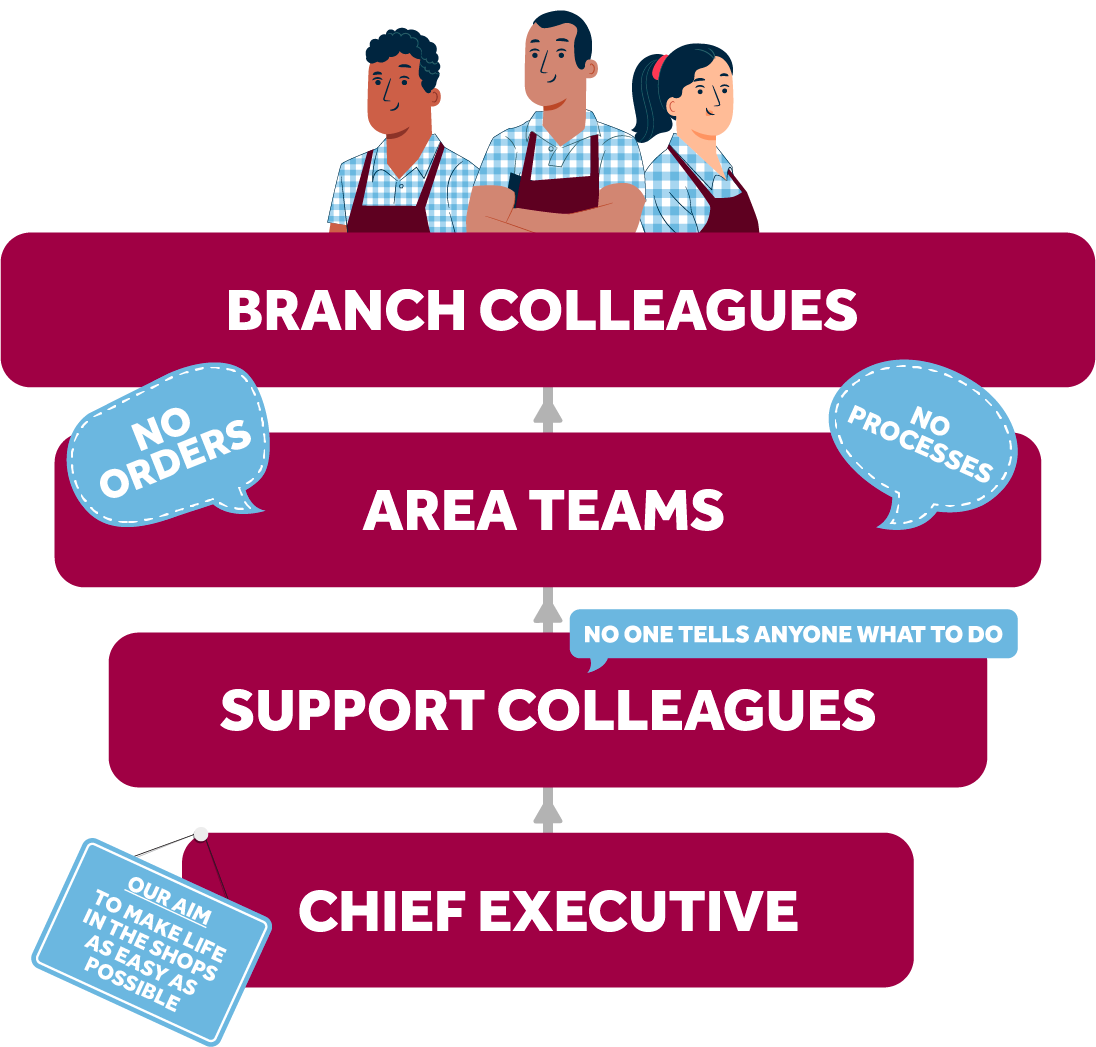
Importantly, Timpson is known for having kindness in its roots. Woven in to how the business runs.
Here are a couple of examples of what I mean:
They have a policy of hiring ex-offenders, putting them straight into customer-facing roles. Trusting them to run shops. It’s kindness in hiring. (Fun Fact: they report lower staff issues in ex-offenders than the rest of the employee population).
Store colleagues get to decide on-the-spot refunds without needing to ask permission. It’s kindness as staff empowerment.
They’ll waive fees for people in difficult situations, like a bereavement or stolen keys, and will fix small things for free with a “don’t worry about it”. It’s kindness as a service model.
If employees make mistakes, they help them get back on track, rather than defaulting to dismissal. It’s kindness as an HR design choice.
They remove rigid scripts and escalation ladders, so employee use judgement instead of covering themselves. It’s kindness as an operating model.
They share bonuses widely, so the people serving customers directly benefit when the business does well. It’s kindness through fairness.
The leadership team shows up when it matters, frequently visit stores, knowing people by name, remembering birthdays and anniversaries, and being there for staff in life’s tough moments. It’s kindness as a leadership behaviour.
None of this is random. It’s a set of deliberate decisions about how the business works: who to trust, who gets to decide, what happens when things go wrong, how value is shared, and how leaders behave.
Sure, they could probably make a bit more profit here and there. But instead they get something more valuable, more important.
They get loyal customers, and a generational business that lasts. Because they’re not chasing transactional targets set by investors with impatient capital.
You see, running a business isn’t just about winning customers. It’s about keeping them.
And being kind can be a smart business strategy.
There are many more company examples out there, but my other favourite is Octopus Energy. They’ve built a reputation on being transparent with customers. Even encouraging them to switch providers or tariff when it’s in their interest.
Guess what happens? It builds trust, which drives positive customer behaviour. From a cold start ten years ago, Octopus is now the largest energy supplier in the UK. And is already expanding to Germany, Spain, France, Italy, Japan and the US.
Why am I making such a laboured point about business kindness?
Because in today’s tech-driven, AI-fuelled and VC-hyped economy, so many businesses are focussing elsewhere. On scale. On efficiency. On growth at all costs.
And we’re now surrounded by companies that describe themselves as “customer obsessed.”
But ‘obsession’ feels like the wrong thing. Would you be comfortable if a teacher said they were obsessed with children? Or a nurse saying he was obsessed with patients?
Somewhere along the way, we’ve confused intensity with care.
What’s missing is balance. What’s missing is kindness.
Kindness isn’t soft or weak or anti-profit. Because it leads to something very practical. Customers trust you more, they stay longer - and here’s the kicker - they share more and better data. It means the business can make smarter decisions, and drive more profits.
So as we rush to build new digital ID systems, digital credential networks, Personal AI platforms and all the rest, let’s think about kindness. And how it can make a difference to all our lives.
Why do I care? Because one of the best parts of my job is that I get to choose who I work with.
And I choose kindness every time.
People kind with their time. People kind with their advice. People kind with their customers. Because it consistently turns out to be the better way to run a business. And frankly, it’s more fun.
If you’re serious about data, personalisation or AI, kindness isn’t a layer on top. It’s got to be part of your business design. And baked into the tech.
It all starts with the choices you make as a company.
So whether your company is upside down or not, like Timpson, it’s never been more important to understand the future of the digital customer. And the future of digital kindness.
Welcome back to the Customer Futures newsletter.
In this week’s edition:
Let’s not throw the (AI accountability) baby out with the (digital ID) bathwater
The Great Customer Reset is here - and it’s going to be fun
Online age checks will disrupt how ID systems work with the web itself
… and much more
Grab a fruit smoothie, we can walk and talk… Let’s Go.
Let’s not throw the (AI accountability) baby out with the (digital ID) bathwater
Some folks got upset this week when Anthropic announced ID verification for Claude users.
“Being responsible with powerful technology starts with knowing who is using it”.
It’s the usual type of ID check, uploading an official ID document (passport, driver’s license, national identity card etc), and matching the biometric to a live selfie.
Why the pushback? Because Anthropic is using the IDV firm Persona.
As Bruni Giussani pointed out:
“A few months back, a data breach revealed that communication app Discord was also using the same tech, and we learned that Persona conducts facial recognition checks against watchlists, screens identities against lists of politically exposed persons, and runs “adverse media” analysis.
The challenge is that most IDV firms will be doing the same.
Persona has faced PR issues because of 1) the recent data breach with Discord, and 2) they are associated with Silicon Valley’s favourite villain Peter Thiel.
So this story is less about Anthropic doing ID checks, and more about their use of Persona.
Should we be able to hold AI users accountable? Absolutely. Especially when Anthropic has recently released Mythos, their latest AI that can detect security vulnerabilities in seconds.
It’s just like we do with other weapons of disproportionate destruction.
With great AI power comes great AI responsibility.
No, we don’t need biometrics to hold people accountable. And we certainly don’t need to give those platforms our raw personal data. That’s just mad.
Because there’s a whole bunch of new digital tools available that can give businesses a high level of assurance about someone, without needing to give them the identity data.
Selective Disclosure. Verifiable Credentials. Digital Wallets.
And the answer doesn’t need to be binary: sharing zero identity or full disclosure. Yes, completely anonymous use of social media has been a mistake. And we don’t want another fiasco of ‘real ID’ (ask Claude or Google if you don’t know).
But we do need pseudonymity with real accountability.
Today’s AI platforms can now do real, material, potentially societal harm. So let’s not throw the (AI accountability) baby out with the (digital ID) bathwater.
We can and must do better folks.
Especially when we’re being asked to share our biometrics with leaky, untrusted ID platforms.
The Great Customer Reset is here - and it’s going to be fun
I love this post by John Roa about what becomes possible with customer-side AI agents.
“I built a better OpenClaw from scratch. The agentic future is going to be fun.”
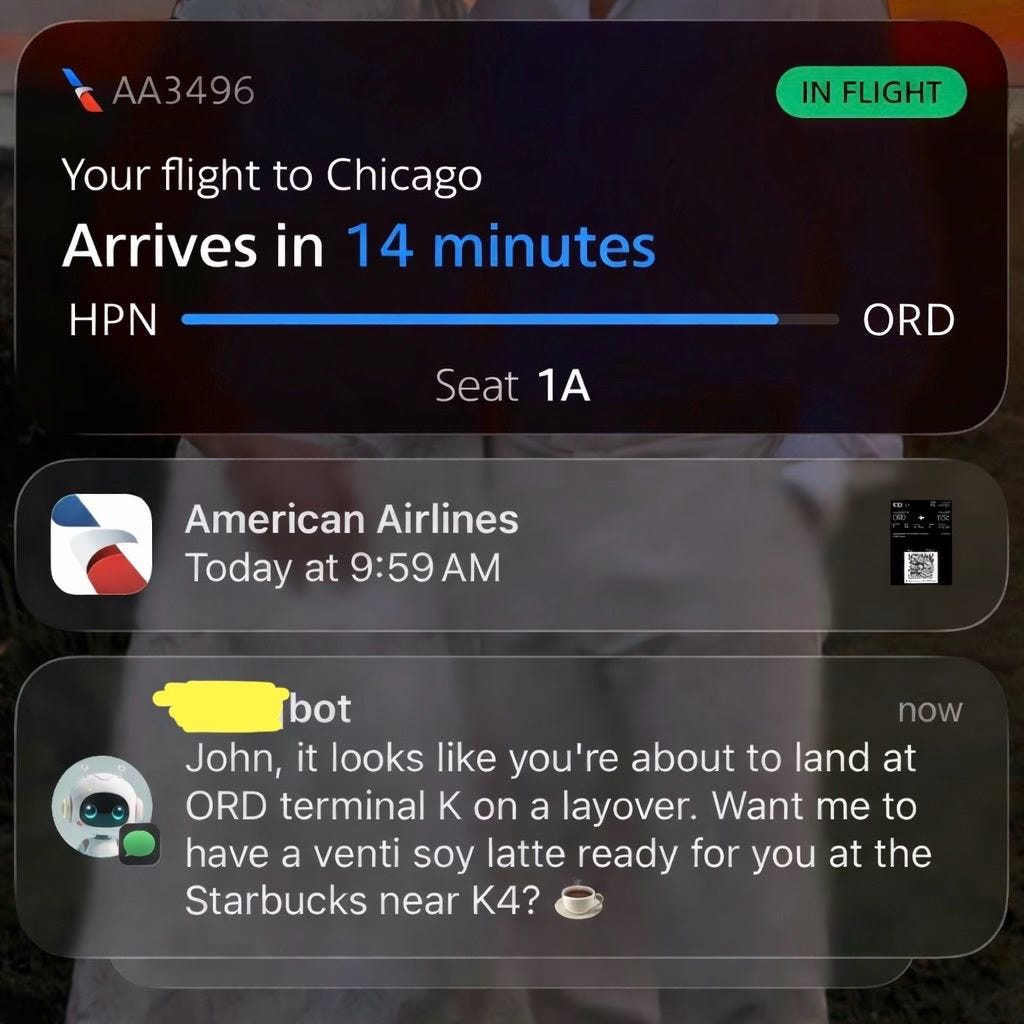
We ain’t see nothing yet.
This is an early glimpse of what’s coming with a next generation of ‘IFTTT’ (If This Then That) micro apps. But this time it’ll be dialled up to 11... and working across the rest of your life. From money and home, to travel and health.
We now just need to sprinkle in some new levels of digital trust, data governance, sustainable commercial models, and a knock-out CX. Because once we give AI Agents:
Their own digital IDs
Provable delegated authority
Scoped mandates (what they can/can’t do)
Verifiable intent (provably something I asked for, so brands can trust the arriving AI agent request)
... we'll empower customers in ways that we can’t yet imagine.
It’s helpful to look to the past to see how this might play out.
During the industrial revolution, the combustion engine gave us a new way to automate human labour. A new mechanical machine. And the first places we used these machines were in business. Replacing mules down the mine. Replacing factory workers.
But the real industrial scale happened when we gave those new mechanical machines to people.
We democratised the machine technology. We empowered customers with personal tools that they could own and control. Things like vacuum cleaners, boilers and cars.
They say that history doesn’t repeat, but it rhymes.
30 years ago, we invented ‘data machines’. Things like CRM platforms, ERP systems, Customer Data Platforms, and more recently, social media.
And just like the industrial revolution, the first thing we’ve done is given the data machines to businesses.
The result? Lots of digital transformation, BigTech, and a weird sort of commercial gravity, where all the money, talent and capital flows into only a handful of rich countries.
But as John brilliantly shows us in his fun I’m-about-to-land-please-get-my-coffee-ready micro app, we’re about to give the ‘data machines’ - Personal AI - to people too.
Today it’s OpenClaw. But much more is coming. We’re about to see today’s data machines show up on the side of the customer - just like vacuum cleaners, boilers and cars.
And a coming customer empowerment revolution.
In March 2022, I called it ‘The Great Customer Reset’.
We ain’t seen nothin’ yet.
Online age checks will disrupt how ID systems work with the web itself
Worth reading this excellent post by Heather Flanagan, pointing out why we’re confused about digital age checks.
She puts it quite simply:
“Everyone says age assurance is about protecting children online. Fair enough. Of course, people will surrender everyone’s privacy if that goal is emotionally compelling enough.
“That’s why so many age assurance debates become muddled. We use one phrase to describe three very different things:
Age verification = prove exact age or date of birth
Age estimation = infer likely age range
Age assurance = confidence that someone meets a threshold
“Those are not interchangeable. They carry different costs, error rates, governance risks, and implementation burdens.
“Technically, privacy-preserving approaches exist. You can prove “over 18” without handing over a passport scan in theory. In practice, the standards, trust frameworks, liability models, and deployment incentives are still immature.
“So many current policy conversations assume infrastructure that does not yet exist at scale.”
Bang on the money.
Especially the point about different costs, error rates, governance risks, and implementation burdens.
Critically, Heather sets out the different ways that age checks - and indeed ID verifications - can take place. And how we’re often mixing them up.
Here’s the simple version:
Platform-level verification: users upload their ID documents or submit some biometric data. It often becomes the default for many online services.
Third-party verification: companies rely on other specialist ‘identity proofing’ businesses to perform the age or identity check, and return a confirmation to the platform.
Digital identity wallets and credentials: A trusted ‘issuer’ provides a credential that includes age attributes, and users can present that credential when required.
It’s a great way to pull this complex market apart, and highlights how different approaches introduce different risks, processes and costs. Not to mention different customer experiences.
I recommend reading Heather’s excellent, longer article. As she puts it:
“Age verification is rapidly becoming one of the most complex intersections of identity, privacy, and public policy on the internet.
And for those working in digital identity, it may also be a preview of the next major shift in how identity systems interact with the web itself.”
Well quite.
OTHER THINGS
There are far too many interesting and important Customer Futures things to include this week.
So here are some more links to chew on:
News: Google Wallet now supports Aadhaar Verifiable Credentials READ
Book launch: Mastering Digital Identity - From Risk to Revenue is now live on Amazon - by the very excellent Eve Maler READ
Announcement: Google just donated its Agent Payments Protocol (AP2) to the FIDO Alliance (alongside Mastercard’s Verifiable Intent) READ
Article: The Delegate Economy stack is maturing faster than anyone expected READ
Announcement: New DIF Agentic ID Standard - Know Your Agent Operating System (KYA-OS) READ
Post: Is Digital Identity Having Its “Suddenly” Moment? READ
Opinion: Your AI Data, Now Up For Auction READ
And that’s a wrap. Stay tuned for more Customer Futures soon, both here and over at LinkedIn.
And if you’re not yet signed up, why not subscribe: