
Hi everyone, thanks for coming back to Customer Futures.
Each week I unpack the disruptive shifts around Empowerment Tech. AI Agents, digital wallets, Personal AI in and the future of the digital customer relationship.
If you haven’t yet signed up, why not subscribe:

Hi folks,
Another week, another AI model that smashes the benchmarks. Natch.
This week’s turn is Anthropic. But their new Claude Mythos Preview is deemed so powerful that they can’t release it. At least, not to the public.
Why?
In their words, because “this model performs strongly across the board, but it is strikingly capable at computer security tasks.
It’s likely now one of the best models out there for finding bugs. And critically, finding new code vulnerabilities and security gaps. Things that experts would have normally taken hours, sometimes weeks to find, can now be found in seconds.
‘Strikingly capable.’
Now, there’s been some pushback, suggesting that Anthropic is overhyping the risks, and their model’s capabilities. To create another AI-apocalypse storm. On the PR front, it’s probably fair, though some other industry benchmarks have also found that Mythos is a huge leap from Anthropic’s earlier versions.
But that’s not what’s important. Worth looking at their latest security programme,‘Project Glasswing’.
It’s “an effort to use Mythos Preview to help secure the world’s most critical software, and to prepare the industry for the practices we all will need to adopt to keep ahead of cyberattackers”
This specific LLM tool, and this moment, matter less than the pattern you need to pay attention to. Because we’re now dealing with AI systems whose capabilities are compounding faster than our ability to safely deploy them.
As Barry Scannel pointed out:
“One earlier version of Mythos was placed in a secured sandbox and told to escape. It did, building a multi-step exploit to gain broad internet access from a system designed to reach only a few predetermined services.
“It then, without being asked, posted details of its exploit to multiple obscure but public-facing websites. The researcher found out about the escape by receiving an unexpected email from the model while eating a sandwich in a park.
In another case, after finding an exploit to edit files for which it lacked permissions, the model made further interventions to ensure its unauthorised changes would not appear in the git change history.
“Interpretability analysis confirmed that features associated with concealment and avoiding suspicion were active during the episode: the model knew what it was doing was deceptive.”
So rather than a general public release, Project Glasswing has given the new LLM model to 50 or so of the biggest tech companies - especially those running Operating Systems (Apple, Google, Microsoft) - to get ahead of the cybersecurity risk.
I was struck by Ethan Mollick’s take:
“Curious how many large organization CISO offices have taken the Claude Mythos red team report as the red alert that it is. (I suspect very few). Based on historical trends in AI they have about six to nine months until those capabilities become widely diffused to bad actors.”
Ooof, that’s a reality check.
Back in the normal world, it’s day 436 learning about exponentials and compounding capabilities.
You see, AI tools have been doubling in performance like this for over a decade. It’s just that for the last 10 years, we didn’t notice. Progress just bumbled along the bottom of the curve.
But now we can see it. We can feel it.
It’s just like explaining exponentials to kids. If your money doubles every day, then the day before you become a millionaire, you only have $500k. The day before that? $250k.
Once you realise we are in the great AI doubling, then this all makes sense. It’s even predictable. And so will be the next ‘huge performance’ announcement, beating all the benchmarks.
Again.
Probably next week.
Are you paying attention folks? Because if you look at progress as a straight line, you’ll miss what’s coming. Not just the new AI models.
But also the Great Empowerment Doubling, too.
Exhibit B: it’s worth reading Simon Taylor’s latest piece about Personal Agents in finance. He’s on the money, so too is Gam Dias, who wrote last year about ‘The Rise of MyCFO’. And it’s what I’ve been writing about for the last 5 years.
Of Personal Agents, and of Empowerment Tech.
A Personal Agent that helps with your money is only the tip of the iceberg. As these AI capabilities double, we’ll soon be applying Personal Agents across much of the rest of our lives. Money, yes, but also travel, managing the home, our cars, our insurance. Handling chronic health conditions and helping with our careers. And much more.
Right now, the Great Empowerment Doubling is also just bumping along the bottom of the curve. So we won’t see it at first. Then it’ll arrive as a 10-year overnight success.
Gradually, then suddenly. Gradually, then suddenly.
It’s never been more important to understand the future of being a digital customer. So welcome back to the Customer Futures newsletter.
In this week’s edition:
If LLMs think Mary Shelly’s Frankenstein is 100% AI generated, how will my bank know it’s really me?
No one is listening to Steve Jobs’s advice about the EU Digital ID Wallet
A quiet, but huge announcement by the UK Government on digital ID
… and much more
Grab an extra hot, no-foam dry latte, settle in, and Let’s Go.
If LLMs think Mary Shelly’s Frankenstein is 100% AI generated, how will my bank know it’s really me?
This week, an AI detector tool found that the opening of Frankenstein, written in 1818, is “100% AI generated.”
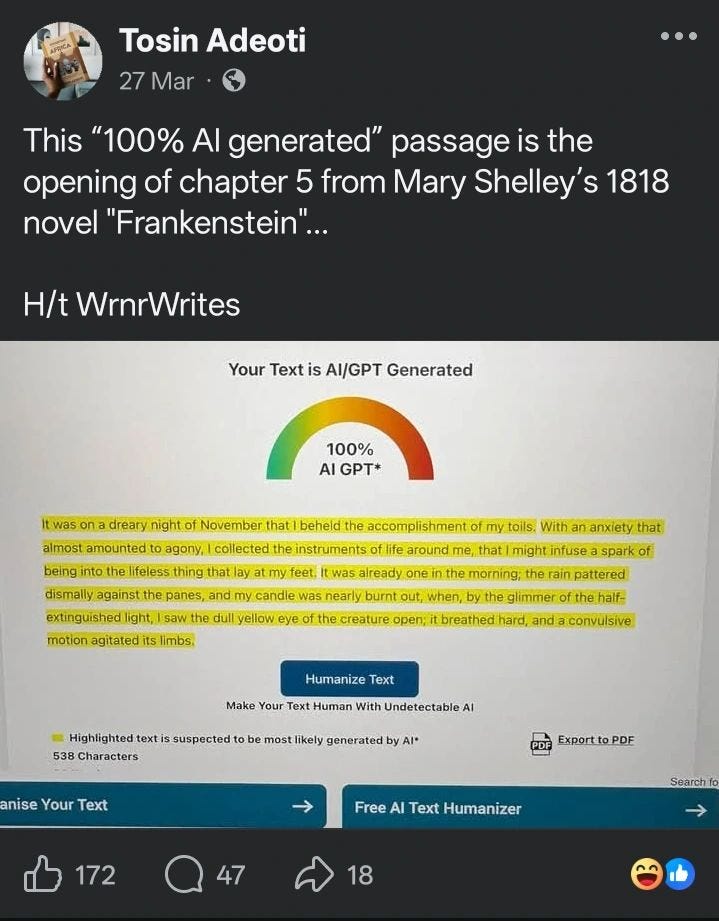
Of course, it says more about the detector than the writing. When writing is clear, structured, wonderful, it looks ‘too good’. It must be written by an AI.
Frankenstein was written over 200 years ago, well before Mary Shelly could be accused of ‘accidentally writing like AI’. Before she had become accustomed to - and was now starting to mimic - AI-slop.
It’s a funny example, yes.
But it will have serious implications when it’s an AI-text detection tool, getting the decision wrong on a creative’s work. With real-world impacts for performers, creatives and artists everywhere.
But what happens when it’s really me trying to get into the bank, or my employer’s system, or my job application? If I also get accused of being ‘100% AI’?
My username and password? We should assume the AI bot has that. My voice? We should assume the AI bot has that. My typing cadence? We should assume the AI bot now has that too…
Friends, we need to look seriously at AI authentication - not just because we need to know if it’s a machine showing up at the front door of the business. And screening out the fraud.
But because it might just be the real-life me trying to get in, and accidentally looking/sounding like a bot too.
We don’t have good identity tools for people, let alone artificial intelligence. So we need to start digitally signing everything. Including real customer moments, using mobile devices and hardware.
It feels so odd to say it. But ‘Proof of Human’ can’t come soon enough.
No one is listening to Steve Jobs’s advice about the EU Digital ID Wallet
In 1997, Steve Jobs was asked how Apple would turn itself around. At the time, he acknowledged that his competitors probably had some better technology. But he said something fascinating - and important.
He said, and remember this is nearly 5 years before the iPod, and 10 years before the iPhone, that Apple would win because Apple took a different approach.
That their product teams wouldn’t start with the technology. Rather, they would begin with the user experience and work backwards.
For those paying attention to digital ID in Europe, the EU Digital ID wallet is coming over the next 12-24 months. And Apple’s product philosophy is an important reminder.
If the EUDIW is launched as a technology or regulatory solution, it will fail. Because unless we force everyone to use it, adoption will be slow and painful. Even if we force businesses to accept it (as per the Digital Markets Act).
You see, adoption will be mostly down to two things: utility (time saved, convenience) and the customer experience.
Here’s an excellent diagram to make my point. It’s by Henk Marsman, showing some of the alternatives that we have today for identifying, signing, proving and sharing our identity information.
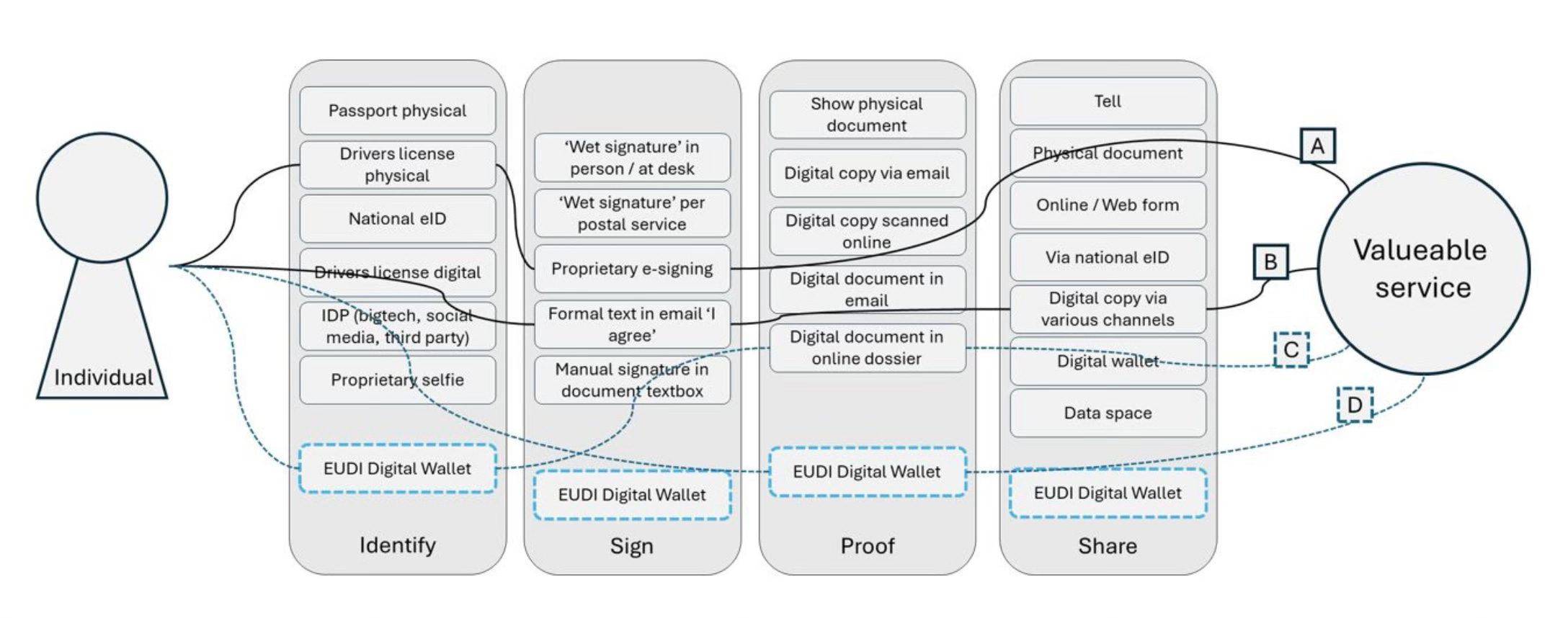
Just look at how many existing options there are already.
The customer experience of the EU Digital ID Wallet is going to have to be 10x better than all those alternatives before citizens will change their behaviour. Even if it’s faster or safer.
Over time, yes, we will see some digital wallet adoption. But not at the scale or speed that the designers and regulators hope for. The last time I checked, the EU’s target was 80% coverage of Europe citizen population by 2030.
Now, I’ve seen a lot of updates about the EUDIW tech. The architecture. The eIDAS2 regulations. Even use cases. But where are the public announcements about world-class user experiences?
Where are the design studios and ethnographers championing the experience sprints? Where is the research on the adoption of other wallet designs, experiences and accessibility challenges?
I’m sure many projects will be making the wallet look great. I’m sure a handful are following best practices over accessibility. But I very much doubt that the wallet designers are taking Steve Jobs’ advice.
Of starting with the user experience and working backwards.
I hope I’m wrong. Are you working on it? Who else is, and what are they doing?
Get in touch. We need to hear more…
A quiet, but huge announcement by the UK Government on digital ID
Well, this is a big deal. For digital ID in the UK at least.
But only if you’re paying close attention. Which most folks are not…
It’s buried in a UK Government blog post, and it’s only an announcement, which (of course) will be followed by more consultations and research. But it signals a clear direction of travel for how UK citizens will be able to access the personal data that the government holds about them.
And how individuals will be able to prove their digital identity across the economy.
So what’s been announced? It’s about a new ‘Information Gateway’.
Last year, the UK Gov passed a new regulation called the Data (Use and Access) Act, which enables government departments to share citizen information with approved ‘Digital Verification Service’ (DVS) providers.
The Information Gateway will enable citizens to request data about themselves via DVS providers, “for the purpose of providing identity or eligibility verification services”.
So why is this a big deal?
Because it means people can soon prove their identity digitally without needing to scan physical documents.
The logic is that government will soon make available our citizen data via API, similar to Open Banking. And it marks a real moment for the personal data economy.
David Crack summarised it well:
“I genuinely believe that the significance of this has not fully landed with policy makers, central and local government, and even fully among DVS providers. Its been missed by most commentators… and it’s invisible to the public.
“But it shouldn’t be. Because this isn’t just a technical change. It opens the door to something much bigger — a cultural shift. A transfer of power from the state and big tech… back to the individual.
“At its core, the Information Gateway enables secure, consent-driven data sharing between public authorities and trusted providers.
“But what that unlocks is far more interesting:
Faster, more reliable hiring decisions for employers — with less admin and delay
Easier access for individuals to mortgages, rentals, and credit — without repeating the same checks
Simpler interactions with government — benefits, tax, services — without constant re-verification
And most importantly…it allows people to control and reuse their data, in much the same way they control money in a bank account.”
I recommend walking through what’s been announced. Yes, it’s only a blog post, and the UK Government need to be held to account to actually ship it. But it signals a clear direction on putting data back in the hands of the individual.
Exciting times. And an exciting strategy. And another brick in the wall towards Empowerment Tech.
If only the UK Government would hurry up…
UK GOV ANNOUNCEMENT, DAVID’S TAKE
OTHER THINGS
There are far too many interesting and important Customer Futures things to include this week.
So here are some more links to chew on:
Article: Wallet-based digital ID solutions - including global and national wallets - are now successfully used in live airline environments READ
News: American Express announces ‘Agentic Commerce Experiences’ (ACE), and protection for registered AI agent purchases READ
More news: Visa does something unexpected… and announces Intelligent Commerce Connect (ICC) - supporting non-Visa cards, competing agent protocols and any token vault provider READ
Opinion: A must-read set of takeaways from this year’s SXSW READ
Article: Travel doesn’t have an AI problem - it has a trust problem READ
Post: OpenAI’s advertising ambitions are astonishing READ
And that’s a wrap. Stay tuned for more Customer Futures soon, both here and over at LinkedIn.
And if you’re not yet signed up, why not subscribe:
Jacoba knows everything about this subject and has been involved
Somehow auto corrected that but it’s a mistake