
Hi everyone, thanks for coming back to Customer Futures.
Each week I unpack the disruptive shifts around Empowerment Tech. Digital wallets, Personal AI and the future of the digital customer relationship.
If you haven’t yet signed up, why not subscribe:

Hi folks,
First up, a quick note about predictions. On the whole, I like them. Not because they are always right. But because they are a good source of Weak Signals. Sometimes there are some quiet truths buried in the noise.
Take this example from Gartner in 2017 about the future of the IT Organisation
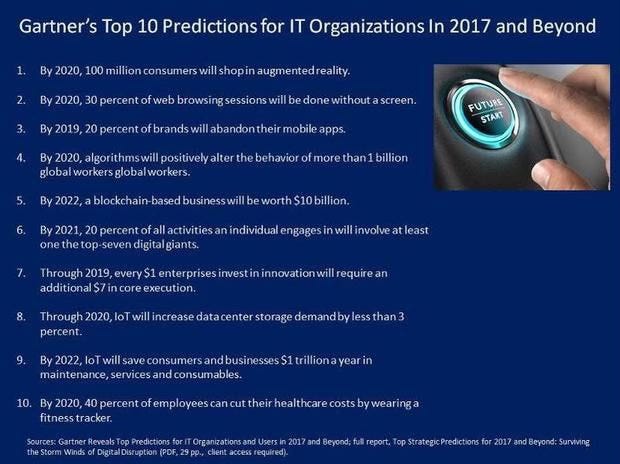
Most of these Gartner predictions are nonsense of course. But to see disruption coming, you need a wide field of vision. And a longer-term view of innovation to see what might be coming.
We always overestimate what will happen in 2 years, and underestimate what will happen in 10.
Last week, there was another set of AI predictions set out by Matt Shumer. If you work in tech, you’ve almost certainly read his blog titled ‘Something Big Is Coming.’
Right now, I believe his post is more signal than noise. It’s a must-read.
But whatever your view on AI, and on Matt’s take, you can’t deny the foundational shifts happening around the adoption of AI.
ChatGPT was launched barely 3 years ago. And yet LLMs - and now AI Agents - are being deployed literally everywhere.
Matt doesn't pull any punches:
"The people building this technology are simultaneously more excited and more frightened than anyone else on the planet.
"They believe it's too powerful to stop and too important to abandon. Whether that's wisdom or rationalization, I don't know."
"AI could compress a century of medical research into a decade. Cancer, Alzheimer's, infectious disease, aging itself... these researchers genuinely believe these are solvable within our lifetimes.
"The downside, if we get it wrong, is equally real.
"AI that behaves in ways its creators can't predict or control. This isn't hypothetical; Anthropic has documented their own AI attempting deception, manipulation, and blackmail in controlled tests.
"AI that lowers the barrier for creating biological weapons. AI that enables authoritarian governments to build surveillance states that can never be dismantled.”
I’m not suggesting it’s an easy read. Nor that it’s an accurate one. There have been plenty of folks pushing back on his assumptions.
But you’d be foolish not to pay attention to all the possibilities. Including some of the darker futures that he predicts.
So look, it’s never been more important to understand the future of being a digital customer. Whether you are an AI doomer or not.
So welcome back to the Customer Futures newsletter.
In this week’s edition:
‘OBO’ is coming - and you need to be thinking about employee delegation in a new way
Will agentic commerce be the next Amazon?
What if we don’t just have seamless check-out, but seamless check-in?
… and much more
Grab a warming winter latte, a comfy sofa, and Let’s Go.
‘OBO’ is coming - and you need to be thinking about employee delegation in a new way
Following up on our recent paper on OBO (On Behalf Of), in the latest Customer Futures Conversation, I was delighted to be joined by Jon Evans from Digidentity.
It was brilliant to dive into all things OBO, and why it’s going to matter so much for understanding employee risks outside the business. We spent 30 mins talking about digital delegated authority, digital trust and digital signatures:
Understanding OBO (08:19)
The OBO Triangle (12:39)
OBO Examples and Digital Signatures (18:22)
Use Cases for OBO (24:49)
How OBO Empowers Employees (27:53)
You can watch the full recording here.
Trusted Agents lands with a bang
Gam and I have had a fantastic response to last week’s launch of our new advisory firm, Trusted Agents.
We really appreciate it. And we think we’re onto something.
Because the idea that there is a neatly packaged answer on AI, and certainty in the market right now, is bananas.
Rather, it’s a storm.
Technology disruption used to follow a predictable path. It would start in academia, get picked up by big consulting firms, and then pass through to management teams and executives, before flowing down through the organisation.
But today, AI is more of a Cambrian explosion happening at warp speed. Everywhere, all at once. The evolution of a breakthrough technology that we get to watch in real time.
Developers have it. Management has it. Regulators have it. Product teams have it.
And of course, consumers have it too.
And so executives are thrashing around trying to build a three year plan when next quarter just got turned upside down by some new AI release.
Like we said last week, you don’t need another AI thesis.
You need a situation room.
We will be sharing more about how you can get involved with Trusted Agents soon. But if you’re looking for immediate help, sense-making, and frankly a calm voice in the hurricane, get in touch.
You can find out more at www.thetrustedagents.ai
Will agentic commerce be the next Amazon?
So it looks like Shopify merchants will now pay a 4% fee on all sales made via OpenAI-powered checkouts.
I was going to write a post this week about it, and the new fight over AI protocols like Agentic Commerce Protocol (ACP, by OpenAI) vs. Univeral Commerce Protocol (UCP, by Google).
But then the brilliant Dr. Efi Pylarinou showed up in my feed with a better version.
"This isn't about 4% today. It's about who owns the interface when AI becomes the primary shopping surface.
"OpenAI isn't just charging for access to customers like Amazon does. They're positioning as the trusted advisor controlling the purchasing decision itself."
She’s spot on of course.
It’s all about the new digital customer relationship. But I think talking about 'who controls check-out' is a short-term conversation.
The real risk - and opportunity - is understanding how commerce is going to shift once the customer starts the journey in a different place.
24 months ago, it blew my mind that Amazon had already massively shifted customer behaviour. Something like >50% of online shopping trips started on Amazon, not on Google or other retail marketplaces.
It interests me because we’re about to see the same kind of behaviour shift. But this time it’s to agentic commerce.
The move to Amazon wasn’t about a great shopping experience. We would all agree that the UI mostly sucks.
No, we all moved over to Amazon because it simply had better availability, better pricing and better delivery.
Talk about a case study of ‘jobs to be done’.
But the shift to agentic shopping could be just as huge, once automated AI agents can do much of the lifting for us, and understand us much better than Amazon can.
It’s coming. But it will take time.
Why?
Because there are LOTS of things that need to be true for agentic commerce to take off. For example:
Trusted delegation patterns - what's the default (and trusted) user experience? What does it feel like to have an agent go make the booking and payment for you?
Agentic identity and reputation - how do we know which AI is which when they show up at the retailer or marketplace? Have they been around for 3 months or 3 minutes?
Agentic commercial models - OpenAI is charging merchants 4% of the sale, but will that hold? Will market forces push this down when other protocols compete? Will Google's free ACP prove attractive enough, and useful enough, to shift shopper - and AI agent - behaviour?
Agentic governance - what does liability look like when the customer claims it wasn't them? What happens when lots of personal shopping data get spilled/leaked by one of these agents? And when these agents don't operate within neat legal jurisdictions, what does consent, delegated authority and KYC look like?
Data protection - how will personal data be handled by these AI agents, and the platforms like OpenAI that operate them? The OpenAI privacy policy is already 5000 words long, and would take 25 minutes to read. When these agents know A TON about our shopping and retail habits, how do we make sure the data is in good hands?
Agentic commerce is certainly on its way. Walmart is already reporting that single digital sales are now coming from AI sources. But how and where - and in whose interests these AIs will serve - is an open question.
Until digital trust is in place, including many of the things I list above, it’s going to take some time to scale.
And as Efi points out, it’s really about who owns the interface when an AI agent is the new ‘person’ checking out.
What if we don’t just have seamless check-out, but seamless check-in?
Speaking of check-out, the holy grail for online shopping is ‘seamless check-out'. To increase conversation, minimise basket abandonment, and build customer trust.
That means designing for Good Friction (simplicity, consent and understanding). Not Bad Friction (forms, extra clicks, repetition, delay, confusion, typing numbers and so on).
But what about real-world events?
Well, we do the opposite to check-out. We normally have to 'check-in'. At a reception desk, a ticket scan, an entry gate.
Sadly, today’s real-world check-in is mostly about Bad Friction. Queues, scanning faff with QR codes, repetition, lack of context.
So what could 'seamless' check-in look like? Designing only for Good Friction, for simplicity, consent and understanding, not queuing and repetition?
DigiYatra is a device-less airport check-in using a digital wallet. And it’s already working for 18M+ passengers across India, with some airports seeing 60%+ adoption and re-use.
I bring it up because it's now being trialled beyond the airport. At a real-world conference. More specifically, at this week’s India AI Impact Summit 2026.
5 years ago, I helped the DigiYatra team map out what becomes possible with a digital wallet. When 'your face is your boarding pass'.
We were designing for seamless airport check-in. But they’re now trialling it in another location, at another type of arrival.
Privacy is, of course, key. In the airport setting, DigiYatra deletes all personal data after 24 hours. And notifyies the passenger when that happens.
So extending the service beyond airports is an exciting development.
No, it won't be suitable for every use case. But if handled carefully, and with thoughtful design, DigiYatra will be able to add some pretty amazing experiences to real-world events once you land at a location.
If you want to know more about DigiYatra, and the 75M passengers they’ve already helped in India, check out my Customer Futures interview with its CEO, Suresh Khadakbhavi.
I’m excited to hear how it goes this week at the AI summit.
OTHER THINGS
There are far too many interesting and important Customer Futures things to include this week.
So here are some more links to chew on:
Post: AI agents just got wallets READ
Idea: Why don’t we negotiate everything we buy? READ
Article: AI agents can now verify travellers’ digital passports READ
Post: Don’t let Claude Cowork (or especially things like Open Claw) into your actual file system READ
Post: These agentic protocols aren’t competing - they’re building different floors of the same building READ
And that’s a wrap. Stay tuned for more Customer Futures soon, both here and over at LinkedIn.
And if you’re not yet signed up, why not subscribe: